
Summary:
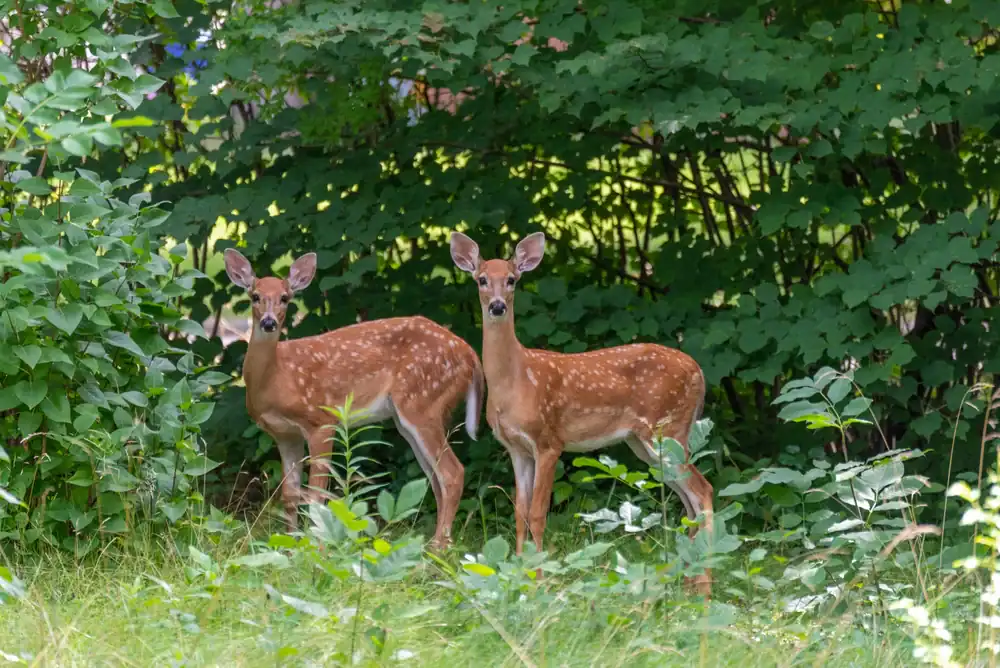
You wake up, walk outside, and the arborvitae you planted along the back fence last spring are stripped bare. Or the hydrangeas you’ve been nursing for three years are gone overnight. If you’re in Nassau County, this isn’t bad luck — it’s a predictable outcome of a deer population that has quietly expanded into communities like Syosset, Muttontown, Westbury, and Levittown over the past several years.
The question most homeowners reach at that point isn’t “do I need help?” It’s “what is this going to cost me?” This guide answers that directly, with real numbers and the context you need to make a good decision.
What Nassau County Homeowners Should Budget for Deer Control in 2026
Professional deer control in Nassau County generally falls into two categories: a one-time seasonal application or an ongoing repellent program.
A one-time fall treatment for an average residential property typically runs around $300. That covers a single application of a weather-resistant repellent before the hardest season — late fall through early winter, when deer food sources thin out and they push aggressively into residential yards across Nassau County.
Ongoing programs are structured differently. Monthly or rotating applications start at roughly $35 to $86 per treatment for average-sized residential lots, with pricing scaling based on property size, the number of vulnerable plants, deer pressure level in your specific area, and whether you’re choosing organic or conventional repellent formulations.
The honest answer is that pricing varies by property. But those ranges give you a realistic floor and ceiling to work with before you call anyone.
Organic Deer Repellent Spraying: What It Costs and Why It's Worth Considering
Organic deer repellent programs tend to run slightly higher than conventional options, and for most Nassau County homeowners with children, pets, or vegetable gardens on the property, that difference is worth it.
The distinction matters more than most people realize. When a company says “eco-friendly” or “all-natural,” that language doesn’t always mean much without specifics. What you’re looking for is whether the products used are OMRI-listed — that’s the Organic Materials Review Institute standard, and it’s the clearest signal that a formulation has been independently verified as safe for use around food-producing plants and animals.
Professional-grade organic repellents are also rain-fast once dry, typically within about an hour of application, which addresses one of the most common concerns homeowners have: “what happens if it rains the next day?”
Retail products you pick up at a hardware store don’t meet the same standard. They break down faster, aren’t formulated for the same longevity, and applying any pesticide-based deer repellent on someone else’s property — or commercially on your own — requires a New York State pesticide applicator license. That’s not a technicality. It’s why professional-grade programs produce results that DIY attempts consistently don’t.
We use formulations that protect your ornamental plantings without putting your vegetable garden, your kids, or your pets at risk. If you’ve been hesitant about professional deer control because of what’s in the spray, organic options remove that concern entirely.
One more thing worth understanding: organic repellents work through a combination of scent and taste aversion. Deer are creatures of habit and memory. A well-maintained program conditions them to avoid your property over time — but that conditioning only holds if applications stay consistent. Skipping a cycle because the yard looked fine last week is usually how programs fail.
One-Time Treatment vs. Ongoing Deer Control Program: Which One Actually Works?
This is the question that trips up most homeowners who are new to professional deer control, and the answer is more nuanced than most providers make it sound.
A one-time fall application can absolutely provide meaningful protection through the winter. Deer damage peaks when natural food sources are scarce — typically from late October through early March on Long Island — and a single well-timed treatment with a winter-grade repellent can carry your plants through that window. If you have a handful of high-value shrubs you want to protect and your deer pressure is moderate, a one-time fall treatment is a reasonable starting point.
The limitation is that repellents break down. UV exposure, rain, and new plant growth all degrade the barrier over time, usually within three to four weeks. A single application doesn’t carry you through spring, when fresh growth brings deer back with renewed interest. It doesn’t account for the summer months, when deer browse continues at a lower but steady rate. And it doesn’t protect plants that weren’t treated in the fall.
An ongoing program — with applications on a three-to-four-week rotation — provides continuous coverage across seasons and adapts to what’s actually happening on your property. Quality programs also rotate between scent-based and taste-based deterrents to prevent deer from habituating to a single product. That rotation matters more than most homeowners expect, because deer are adaptable. A repellent that works brilliantly in October can stop working by December if the animals have had enough exposure to it.
For Nassau County properties with significant landscape investment, an ongoing program is almost always the more cost-effective choice when you factor in replacement costs. A single established arborvitae or ornamental shrub can run $150 to $500 to replace. A season of professional deer control costs less than replacing two plants.
Why Deer Control in Nassau County Requires a Different Approach
Nassau County has a deer problem that most residents didn’t see coming — and it’s getting worse. The deer population that was historically concentrated in wooded North Shore communities like Oyster Bay Cove, Locust Valley, and Cold Spring Harbor has steadily expanded westward and southward into denser suburban communities.
Levittown, Bethpage, Westbury, Massapequa — these are places people don’t typically associate with wildlife pressure, and yet documented deer activity in those communities has increased meaningfully over the past several years. There are no natural predators in Nassau County to check that growth.
Unlike municipalities in Suffolk County — Babylon, Huntington, Islip, Smithtown, Southampton — Nassau County residents cannot obtain Deer Damage Permits from the NYSDEC. Hunting-based removal simply isn’t available here. That makes professional repellent programs not just one option among many, but effectively the primary practical tool Nassau County homeowners have.
Understanding Deer Pressure in Nassau County
Long Island is home to an estimated 25,000 to 30,000 deer, according to the New York State Department of Environmental Conservation. Ecologists generally consider 10 to 15 deer per square mile a sustainable density for forest health. Suffolk County already averages 27 to 39 deer per square mile across much of the county.
Nassau County’s numbers are harder to pin down precisely, but the westward expansion into communities along the Northern State Parkway and Southern State Parkway corridors is well-documented. What that means practically for homeowners in Syosset, Muttontown, and similar Nassau County communities is that deer aren’t occasional visitors anymore. They’re using residential landscapes as regular foraging territory.
The damage pattern is different from what you’d see in a rural or lightly developed area — deer here are navigating smaller parcels, which means every ornamental planting on your property is within easy reach.
There’s also the tick question, which Nassau County homeowners with young children take seriously. Deer are the primary reproductive host for the black-legged tick, which transmits Lyme disease and Powassan virus. Nassau County sits in a high-risk zone for both. A deer repellent program that reduces deer activity on your property also reduces tick deposition in your yard — that’s not a secondary benefit, it’s a meaningful public health consideration for families spending time outdoors.
The other factor specific to Nassau County is Long Island’s soil. The sandy, glacial soil that runs throughout the county is already nutrient-poor and fast-draining, which stresses ornamental plants under normal conditions. When deer browse strips foliage, removes new growth, or injures bark, those plants are slower to recover here than they would be in a region with richer soil. That stress compounds over time and creates openings for secondary disease and pest pressure.
Plant Health Care Services After Deer Damage: What Recovery Actually Requires
Most deer control providers focus entirely on prevention. That’s useful as far as it goes, but it leaves a significant gap for homeowners whose plants have already been browsed — sometimes heavily, sometimes for multiple seasons in a row.
Deer browse damage isn’t just cosmetic. When deer strip the lower foliage from a shrub repeatedly, they alter its growth structure. When they rub antlers against tree trunks during the fall rut, they can girdle bark in ways that compromise the tree’s vascular system. When they remove apical growth — the terminal buds at the tips of branches — they disrupt the plant’s natural form and can trigger stress responses that make it more susceptible to fungal disease and secondary pests.
A pure-play deer repellent company will spray your property and move on. What they won’t do is assess whether your already-damaged plants are recovering, identify secondary disease that’s taken hold in the wake of deer stress, or recommend treatment for plants that need more than just protection going forward.
This is where our background as a certified arborist practice changes what we’re able to offer. Thomas Jones is a New York State Board Certified Arborist, which means when we’re managing a deer control program on your property, we’re also looking at your plants through a plant health care lens. If your arborvitae screen has been browsed down and is struggling to push new growth, we can address that directly. If a tree shows signs of bark damage from rutting, we can assess the structural impact and recommend a course of action.
Deer control and plant health care aren’t separate problems. They’re connected. The deer created the damage; the plant health care services address what the damage left behind. We offer both — and the fact that the same person handles every visit means nothing gets missed between appointments. That continuity is something no crew-rotation company can replicate.
Getting Deer Control Right in Nassau County: Where to Start
If you’re pricing deer control for the first time, the most important thing to understand is that the cost of doing nothing keeps compounding. Every season without protection is another season of plant loss, and in Nassau County — where replacement costs are high and hunting permits aren’t an option — a professional repellent program is the most practical way to hold the line.
A one-time fall treatment is a reasonable starting point for moderate pressure situations. An ongoing program is the right call for properties with significant landscape investment or heavy deer activity. Organic options are available and effective for homeowners with safety concerns around children, pets, or vegetable gardens.
If you’re not sure which approach fits your property, that’s exactly the kind of conversation we’re set up to have. We offer no-fee, no-obligation consultations — Thomas Jones will walk your property, assess your deer pressure and plant conditions, and give you a straight answer about what makes sense. No pressure, no upsell. Just an honest look at what your landscape actually needs.