Summary:
You’ve probably tried something already. A hose-end spray from the hardware store, maybe a fogger before a party. It helped for a day or two — then the mosquitoes came back like nothing happened. That’s not a fluke. It’s what happens when the product isn’t matched to the problem, and the problem in Nassau County is more layered than most people expect.
Nassau County’s combination of mature tree canopy, dense shrubs, coastal humidity, and heavy soils creates conditions where mosquitoes don’t just visit your yard — they live there. Understanding what you’re actually spraying for, and why, is the first step toward a backyard you can use again.
Mosquito Repellent for Your Yard: What Are Your Actual Options?
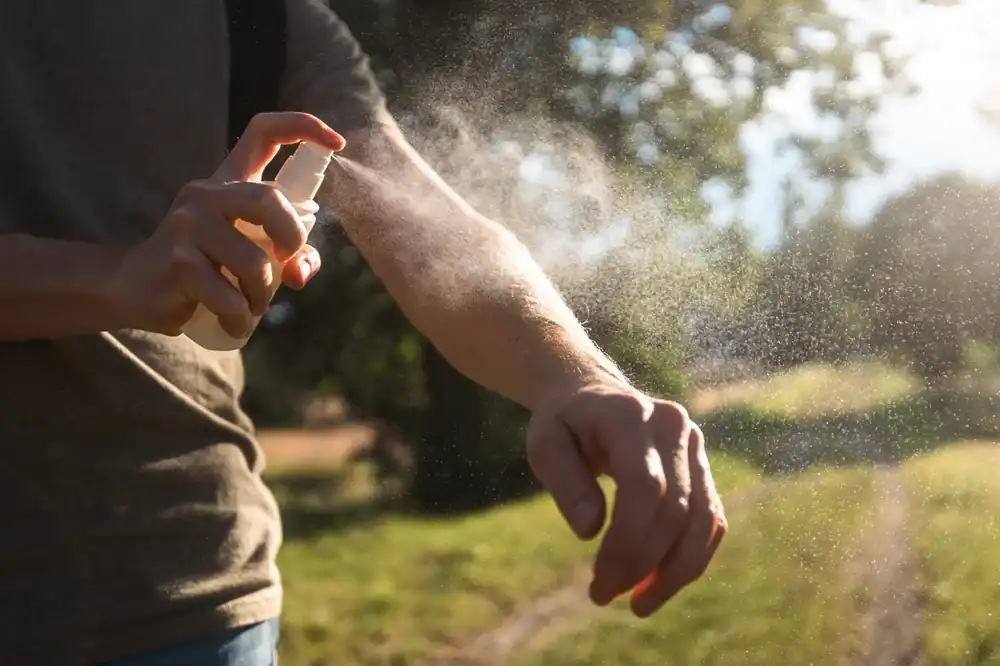
There are three broad categories of mosquito control for residential yards: synthetic barrier sprays, organic plant-based treatments, and DIY retail products. Each one works differently, lasts a different amount of time, and fits a different set of priorities. The right choice depends on your yard, your household, and how much mosquito pressure you’re actually dealing with.
Synthetic pyrethroids — the active ingredients in most professional-grade conventional sprays — deliver fast knockdown and residual control that can last three to four weeks, even through light rain. Organic options, typically formulated from essential oils like cedar, lemongrass, or garlic-based concentrates, work through a different mechanism and generally need reapplication every seven to fourteen days.
DIY retail products sit somewhere in between, but usually underperform in real-world conditions because of how and where most homeowners apply them.
Why Does Organic Mosquito Spray Need to Be Applied More Often?
The short answer is that organic formulations don’t bind to plant surfaces the same way synthetic pyrethroids do. Pyrethroids are designed to adhere to vegetation and maintain residual activity even after light rain. Essential oil-based products dry quickly and repel on contact, but they break down faster — especially in humid conditions, which describes Nassau County’s summers almost perfectly.
When you’re sitting between the Atlantic and Long Island Sound, elevated humidity is just part of the season. That said, “needs more frequent application” is not the same as “doesn’t work.” When organic treatments are applied on the right cycle — typically every 21 days for a professional program, adjusted as needed — and targeted to the right zones, they’re genuinely effective.
The issue most homeowners run into isn’t the formula. It’s that they’re spraying the wrong places.
Mosquitoes don’t spend their days hovering over your lawn waiting to bite you. During daylight hours, they rest in shaded, moist vegetation — under deck boards, deep in arborvitae hedges, inside dense rhododendron, beneath low-hanging shrubs along your foundation. Open lawn is largely irrelevant to them.
A retail spray applied across the grass may look thorough, but it’s missing the places where the mosquitoes actually are. That’s why so many homeowners try a DIY product, feel like it worked at first, and then find themselves right back where they started within a few days.
One more thing worth knowing about organic labels: “all-natural,” “organic,” and “OMRI-Listed” are not interchangeable terms. All-natural means the ingredients are free of synthetic chemicals. Organic refers to how the ingredients were farmed and harvested. OMRI-Listed — the Organic Materials Review Institute certification — is the verifiable third-party standard that confirms a product is approved for use in certified organic operations.
If a company is telling you their treatment is “organic” without being able to explain what that means specifically, that’s worth asking about before you commit to a seasonal program.
Is Synthetic Mosquito Spray Safe for Kids and Pets?
This is the question we hear most often, and it’s a fair one. Professionally applied synthetic pyrethroid sprays are considered safe for children and pets once they’ve dried — which typically takes one to two hours after application. The re-entry window exists because the product is wet and concentrated immediately after spraying. Once it’s set into the vegetation, the residual level that remains is far lower than what was applied.
Organic treatments dry faster — usually within 30 to 60 minutes — and are generally considered safe once the essential oil odor dissipates. If you have a vegetable garden, fruit trees, or flowering plants you’re actively trying to protect for pollinators, garlic-based and essential oil concentrates are worth considering specifically because of how they behave around edible crops and beneficial insects.
What matters most isn’t just the product — it’s who’s applying it and how. A certified arborist assessing your property before treatment is going to make different decisions than a franchise technician running a standard route. They’ll notice that your oak canopy is creating a shaded microclimate near your patio. They’ll flag that the low spot near your fence line is holding water after rain. They’ll adjust the application zones based on what your yard actually looks like, not a one-size template.
For Nassau County homeowners on the North Shore — Oyster Bay, Locust Valley, Glen Cove — wooded hillsides and harbor moisture create layered mosquito habitat that extends from ground-level shrubs up through mid-canopy. South Shore communities like Massapequa, Merrick, and Bellmore deal with a different profile: canal-adjacent properties, tidal moisture, and coastal humidity that keeps breeding conditions active longer into the season.
The treatment approach should reflect that. A good program accounts for your specific yard’s conditions — not just the county you live in.
Mosquito Lawn Treatment: Why One Spray Isn't Enough in Nassau County
Nassau County has had a formal mosquito control program since 1915 — one of the oldest in the country, launched in response to malaria outbreaks. The county’s Department of Public Works still runs active surveillance and spray operations today. But here’s what that program covers: public spaces, wetlands, and drainage infrastructure. Your backyard is not on their route.
That gap — between county-level control and private residential yards — is exactly where mosquito pressure builds through a Nassau County summer. And the biology doesn’t help. Mosquito eggs can hatch in a matter of days once submerged in standing water.
The Asian tiger mosquito, which is particularly active in Nassau County’s dense suburban neighborhoods, needs only a quarter-inch of water to complete its life cycle — the amount that collects in a plant saucer, a bottle cap, or a section of clogged gutter.
How Often Should You Spray Your Yard for Mosquitoes on Long Island?
Professional programs are built around a 21-day cycle — and that timing isn’t arbitrary. It’s designed to interrupt the mosquito breeding cycle before larvae develop into biting adults. If you wait longer between treatments, you’re giving new generations time to establish.
If you start a program in July, you’ve already missed two or three treatment windows during the peak of the season. Nassau County’s coastal position keeps humidity elevated through the summer, which means mosquito activity extends longer here than in drier inland markets. That’s not a reason to panic — it’s a reason to start early and stay consistent.
A program that begins in May and runs through October on a regular cycle is fundamentally different from a single spray applied before a party. One manages the population. The other provides temporary relief.
The Northern house mosquito (*Culex pipiens*) — the primary West Nile Virus vector in Nassau County — stays within roughly 300 feet of its breeding site. So if you’re dealing with Culex mosquitoes in your yard, the source is close. It might be a low spot in your lawn that holds water after rain, a birdbath that isn’t being changed frequently enough, or a section of gutter that’s draining slowly.
By mid-September 2024, Nassau County had recorded 56 West Nile Virus-positive mosquito samples — a significant number, and a reminder that mosquito pressure here is a public health issue, not just a nuisance. A seasonal program that eliminates breeding sites and applies treatment on a consistent schedule is the only approach that actually addresses that.
Mosquito Treatment for Your Yard and Tick Control: Why a Combined Program Makes Sense
Most homeowners think about mosquitoes and ticks as separate problems that require separate solutions. In practice, they share the same habitat — and treating them together is both more effective and more practical than running two independent programs.
Both pests rest in shaded, moist vegetation during the day. The same dense arborvitae hedge that shelters mosquitoes from the midday sun is where ticks wait for a passing host. The same wooded edge along your property line that creates ideal mosquito breeding conditions is where deer carry black-legged ticks into your yard.
A single targeted application to those zones addresses both threats at once, rather than doubling the number of visits and the amount of product applied to your property.
This matters especially in Nassau County’s North Shore communities — Oyster Bay, Old Westbury, Locust Valley — where white-tailed deer populations are significant and tick pressure runs high alongside mosquito season. Suffolk County ranks among the highest-incidence counties in the country for Lyme disease, and Nassau County is not far behind.
If you’re already thinking about mosquito spray for your backyard, it’s worth asking whether the program you’re considering covers ticks as well, and whether the provider can explain specifically how the two treatments are integrated.
There’s also a broader property health dimension that most pest control companies don’t address. Stressed trees create more favorable mosquito habitat — they produce more shade, drop more debris, and create more moisture-retaining conditions at ground level. Overgrown foundation shrubs harbor both mosquitoes and ticks.
A certified arborist looking at your property before treatment isn’t just checking boxes — they’re reading your yard as a system and identifying conditions that create ongoing pest pressure, not just the symptoms you’re calling about today. That integrated perspective is something a general pest control franchise isn’t equipped to offer, because it requires a different kind of expertise.
Choosing the Right Mosquito Spray Program for Your Nassau County Yard
The choice between organic and synthetic mosquito spray isn’t really about which one is better in the abstract — it’s about which one fits your yard, your household’s priorities, and the level of pressure you’re dealing with. Both can work. Both have tradeoffs. And neither one, applied once, is going to solve a Nassau County mosquito problem that’s been building since May.
What actually makes a difference is a program designed around your specific property — where the shaded resting zones are, where water is collecting after rain, whether your tree canopy is creating conditions that favor breeding, and whether ticks are part of the picture too. That kind of assessment requires someone who understands plant health, not just pest control.
We offer free on-site consultations with no obligation. Thomas Jones is a NYS Board Certified Arborist who has been working across Long Island since 2014 — and he’ll be the one walking your property, not a rotating technician. Reach out by phone or text and find out what your yard actually needs.