Summary:
Finding a tick on your dog after a walk around the yard has a way of making the problem feel suddenly very real. You start wondering how many you’ve missed, whether the kids are safe playing outside, and what it would actually take to get the situation under control. A quick search for tick spray for yard brings up a lot of options — but not a lot of honest answers about what you actually need. This page is meant to change that. We’ll walk you through how professional tick treatment works, what organic options genuinely offer, and how to figure out whether a seasonal program is the right call for your Nassau County property.
What a Professional Tick Treatment for Your Yard Actually Involves
Most people assume tick spray means someone shows up and sprays the whole lawn. That’s not quite how it works — and if a company is doing it that way, that’s actually a red flag. Ticks don’t live in open, sunny grass. They live in the shaded, humid, brushy margins: the leaf litter along your fence line, the stone walls on older North Shore properties, the dense shrub borders where your yard meets the tree line, the wood pile you haven’t moved in two seasons.
A proper tick treatment starts with identifying those zones on your specific property before anything gets applied. That targeted approach means less product used overall, better results where it counts, and far less impact on the pollinators and beneficial insects living in your garden beds.
Why Nassau County yards need more than one application per season
Tick season on Long Island runs from April through November. That’s nearly eight months of active exposure — and tick activity doesn’t move in a straight line across that window. There are three distinct peaks you need to account for.
The first is late spring, when nymphal ticks emerge. These are the ones most responsible for Lyme disease transmission — they’re roughly the size of a poppy seed, which means they’re easy to miss on a tick check. They’re most active from May through July, which makes early spring the highest-urgency window for a first application.
Summer brings continued adult tick activity alongside peak mosquito pressure, which is why many Nassau County homeowners opt for a combined program during those months. Then fall arrives — and this is the part a lot of people miss entirely. Adult deer ticks peak again in September and October. If you only sprayed in May and consider yourself done, you’re leaving your yard unprotected during one of the most active periods of the year.
The practical implication is that a single application, even a well-applied one, doesn’t cover the full season. Synthetic treatments applied in early spring can hold for two to three months under normal conditions. Natural spray formulations typically need reapplication every four to six weeks, and sooner after any heavy rainfall. A consistent seasonal program — timed to those three activity windows — is what actually keeps tick pressure down across the full outdoor season. One treatment might reduce what’s out there right now. A program prevents the population from rebounding.
This matters especially in Nassau County’s North Shore communities — Oyster Bay, Syosset, Jericho, and Woodbury — where mature wooded lots, established deer corridors, and stone wall borders create exactly the kind of layered tick habitat that a single spray won’t fully address. South Shore properties in Massapequa, Wantagh, and Merrick deal with coastal humidity and wildlife movement patterns that keep tick pressure active well into fall.
Why a certified arborist approaches tick control differently than a pest control company
Here’s something most tick spray providers won’t bring up: pesticide applications don’t just affect ticks. Depending on the product, the concentration, and where it’s applied, they can also affect your trees, your ornamental shrubs, your garden beds, and the soil health underneath all of it.
A generic exterminator is trained to eliminate pests. That’s a legitimate skill. But they’re not typically trained to understand how a given application might stress a mature red oak, damage an established azalea border, or affect the soil biology that your ornamentals depend on. If you’ve invested in your landscape — and on most Nassau County properties, that investment is significant — that gap in knowledge is worth thinking about.
Thomas Jones, who leads our team at Jones Tree and Plant Care, is a NYS Board Certified Arborist. That credential requires passing a comprehensive exam and ongoing continuing education in tree and plant health. It means that when we design a tick spray program for your property, we’re looking at the whole picture: where the ticks are, what products are appropriate for those zones, and how to apply them in a way that doesn’t compromise the trees, shrubs, and ornamentals you’ve spent years building.
We also take an integrated pest management approach — which means we assess the source of the problem before we start treating it. Where are ticks breeding and resting on this specific property? What habitat conditions are driving the population? That assessment shapes the treatment plan, rather than defaulting to a blanket application schedule that ignores what’s actually happening in your yard. It’s a more deliberate process, and it produces better results over time.
Flea and tick yard treatment: What pet owners should know
If you have a dog, there’s a good chance your yard’s tick problem first announced itself through your pet. Dogs are efficient tick collectors — they move through exactly the kind of brushy, shaded edges where ticks wait, and they bring whatever they’ve picked up straight back into the house. Cats that go outdoors do the same.
A flea and tick yard treatment addresses the problem at the source rather than just managing what ends up on your pet. The treatment zones for a combined flea and tick program overlap significantly — leaf litter, shrub borders, lawn edges near wooded areas — which means a well-designed yard program handles both without requiring two separate service calls.
This is probably the most common question we get from Nassau County homeowners who have kids and pets and aren’t comfortable with synthetic chemicals in their yard. The honest answer is: organic tick spray works, but it works differently than synthetic options, and understanding that difference matters when you’re building a program.
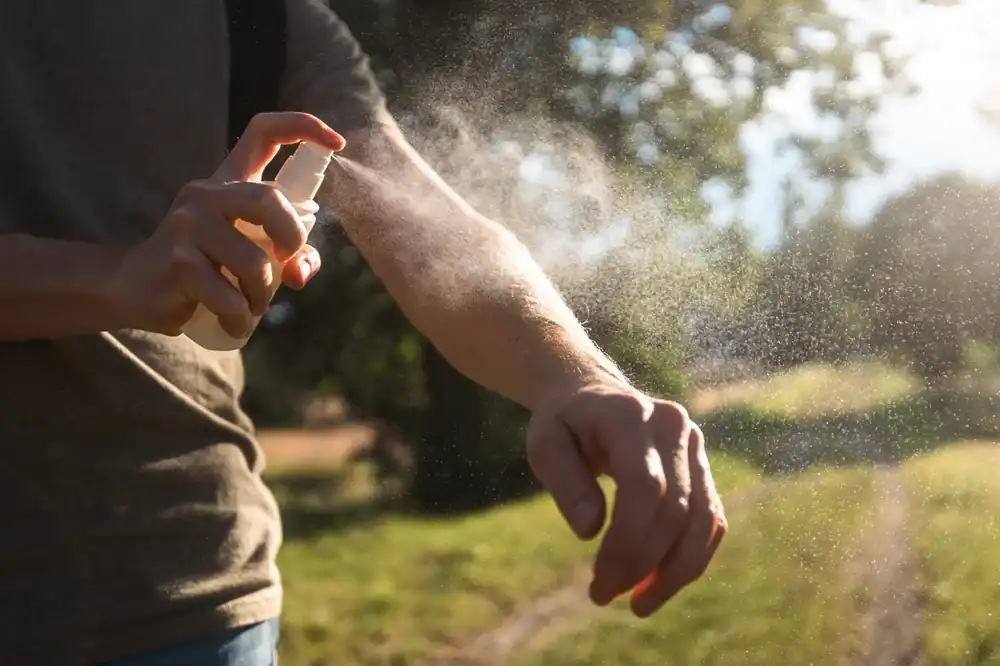
Organic tick spray formulations use active ingredients derived from plant sources — cedar oil, rosemary-based compounds, clove oil, and similar botanicals. These ingredients kill ticks on contact and provide a repellent effect in treated areas. They’re non-toxic and biodegradable, which makes them genuinely safer around children, pets, and vegetable gardens. They’re also registered with the EPA as pesticides — “natural” doesn’t mean unregulated.
The tradeoff is durability. Natural formulations break down faster than synthetic options, especially in outdoor conditions. In normal weather, you’re looking at reapplication every four to six weeks. After a heavy rain, possibly sooner. That’s not a flaw in the product — it’s the nature of the chemistry — but it does mean your program needs to be structured around that reality. A provider who sells you an organic program on a schedule designed for synthetic products isn’t giving you accurate expectations.
We’ve been working in organic tick control on Long Island for over ten years, and we offer both organic and conventional options for exactly this reason. Some properties and some households are best served by a fully organic program. Others benefit from a hybrid approach — organic applications during high-traffic outdoor months, with a more durable synthetic treatment in early spring when you’re trying to knock down the nymph population before it peaks. We don’t have a one-size approach because the properties we work on aren’t one-size. A wooded lot in Oyster Bay with a vegetable garden and three kids has different needs than a South Shore property with a fenced yard and a single dog.
What we won’t do is oversell organic effectiveness to close a sale. Some research has shown that natural products have limitations compared to synthetic options under certain conditions. We’d rather give you an honest program that delivers real results than a comfortable story that leaves you still finding ticks in July.
Tick control for your yard: Common questions Nassau County homeowners ask
**How soon can my kids and pets go back in the yard after treatment?** With our organic formulations, re-entry is typically safe once the application has dried, which usually takes ten to fifteen minutes under normal conditions. We’ll always give you specific guidance based on what was applied and where.
**Does rain wash away the tick spray?** It can, depending on the product and the amount of rainfall. Heavy rain — generally more than an inch within twenty-four hours of application — can reduce effectiveness and may require a follow-up treatment. This is one reason we time applications carefully and communicate openly about what to expect after each visit. It’s also a reason why organic programs require more frequent reapplication than synthetic ones: they’re more susceptible to weather breakdown.
**Can I just do one treatment and be done?** For a one-time event — a graduation party, an outdoor wedding, a summer gathering — a single treatment before the event is a reasonable approach and something we offer. For ongoing protection across the full outdoor season, one treatment won’t hold. Tick season in Nassau County runs April through November, and tick activity peaks multiple times across that window. A single May application leaves your yard unprotected by midsummer and entirely exposed during the fall adult tick peak in September and October.
**What if I already have a lawn care company?** Tick control and lawn care aren’t the same service, and most lawn care companies don’t include targeted tick treatment in their programs. More importantly, if your lawn care company is also applying pesticides without a certified arborist on staff, there’s no one evaluating the impact of those applications on your trees and ornamental plantings. We work alongside existing lawn care relationships regularly — our role is specifically the tick program and overall plant health, and the two services complement each other when they’re coordinated.
**Do ticks only come from deer?** This is one of the most persistent misconceptions we run into. Deer are significant hosts for adult ticks, which is why high deer density in communities like Jericho and Woodbury correlates with higher tick pressure. But the white-footed mouse is actually the primary reservoir for the Lyme disease bacterium, and squirrels, chipmunks, birds, and household pets all carry and transport ticks as well. Treating your yard addresses the ticks themselves — regardless of what brought them there.
Is a seasonal tick spray program worth it for Nassau County properties?
For most Nassau County homeowners with wooded lot edges, established landscaping, pets, or kids who spend time outside between April and November — yes, a seasonal program is worth it. A single application can reduce what’s present right now. A program prevents the population from rebuilding across all three activity windows that define tick season on Long Island.
The more important question is whether the program is designed around your actual property — its specific tick habitat zones, your household’s needs, and an honest assessment of what organic versus conventional options will realistically deliver on your timeline.
That’s the conversation we start with a free on-site consultation. If you’re ready to talk through what your Nassau County yard actually needs, reach out to Jones Tree and Plant Care. We’ll take a look at the property, give you a straight answer, and build a program that makes sense for your situation.