Summary:
If you’ve got a tree that’s dead, leaning, or just looks wrong after the last storm, the first thing you want to know is what it’s going to cost. That’s completely reasonable. The problem is that most of what you’ll find online is national data that has almost nothing to do with what tree removal actually costs on Long Island. Smithtown is not Phoenix. The trees are bigger, the lots are tighter, and the rules are different. We’ve put together this guide to give you real Suffolk County pricing for 2026, explain what actually moves the number up or down, and help you understand when a removal quote is fair — and when it isn’t.
Tree Removal Prices in Smithtown, NY: What to Expect in 2026
The average tree removal cost in Suffolk County runs around $1,400, with most jobs falling somewhere between $500 and $2,300. That’s meaningfully higher than the national average of $750 — and it’s not because Long Island companies are gouging anyone. Labor costs here are higher, the trees tend to be older and larger, and working around houses, fences, and utility lines in a dense suburb like Smithtown takes more time and skill than dropping a tree in an open field.
Smaller trees under 30 feet typically run $150 to $500. Medium trees in the 30-to-60-foot range usually land between $400 and $1,200. Once you’re dealing with a large oak or maple over 60 feet — which is common on older Smithtown properties — you’re looking at $1,200 to $3,000 or more, depending on how complicated the job is. Emergency removals after storm damage push those numbers higher still.
What Makes Tree Removal Cost More in Smithtown?
Size is the biggest driver, but it’s far from the only one. The tree’s location on your property matters just as much as how tall it is. A 50-foot oak in the middle of an open backyard is a very different job than the same tree leaning over your roof or growing up against a fence line. Tight access means slower, more technical work — and that shows up in the price.
Tree species plays a role too. Dense hardwoods like oaks and maples take longer to cut and process than softer species. Smithtown’s North Shore is loaded with mature oaks, which is part of why local pricing runs higher than the national norm. The condition of the tree also matters. Dead trees can be unpredictable — they don’t always fall the way a healthy tree does — and that unpredictability requires more careful rigging and a more experienced crew.
Then there’s the stuff people don’t always think about upfront. Stump grinding is almost always a separate cost — it’s not included in the base removal quote unless you specifically ask. Debris hauling and chipping may or may not be included depending on the company. And in Smithtown and most of Suffolk County, you’ll need a municipal permit before any tree comes down, which adds both time and a fee to the process. Permit fees in Smithtown typically run $50 to $200, but if you skip the permit entirely, the fine can reach $10,000. That’s the actual penalty under local ordinance.
One more thing worth knowing: Long Island’s sandy glacial soils affect root stability in ways that influence how a removal gets approached. Trees growing in shallow, sandy soil sometimes have root systems that spread wide rather than deep, which affects how the tree behaves when it comes down. That’s the kind of thing a crew that works exclusively on Long Island understands in a way that a general contractor from elsewhere simply doesn’t.
When the Tree Might Not Need to Come Down at All
This is the part most cost guides skip entirely — and it’s probably the most important thing to understand before you call anyone.
A lot of trees that look like they need to come down are actually responding to a treatable condition. Oak wilt killed red oaks across Long Island in recent years. Spotted lanternfly is confirmed in Suffolk County and causes visible crown damage that can look like a dying tree. Emerald ash borer has worked its way through ash populations across the Island. All three of these are active threats in this area right now, and all three can cause a tree to look far worse than it actually is — or trigger a decline that could have been stopped earlier with the right treatment.
A mature red oak on a Smithtown property can add $30,000 or more to a home’s value. That’s not a number to take lightly. If someone shows up, looks at your tree for two minutes, and tells you it needs to come down, the right response is to ask whether they’re actually qualified to make that call. A certified arborist — specifically a NYS Board Certified Arborist, which requires passing a state board examination — is trained to distinguish between a tree that needs to be removed and one that needs to be treated. That distinction is worth a lot.
We’ve seen plenty of trees in Smithtown and across Suffolk County that a less experienced crew would have taken down. Some of them just needed deep root fertilization and a targeted spray program. Others had soil compaction issues that an air spade treatment could address. The point isn’t that every tree can be saved — some genuinely can’t. The point is that you deserve an honest assessment from someone qualified to give one, not a removal recommendation driven by a sales quota.
Get a Tree Removal Quote from a Certified Arborist in Smithtown
Anyone who gives you a tree removal price over the phone without seeing the tree is guessing. That’s not how legitimate tree work gets quoted. The size, species, location, condition, and access all have to be evaluated in person before a real number can be put on the job.
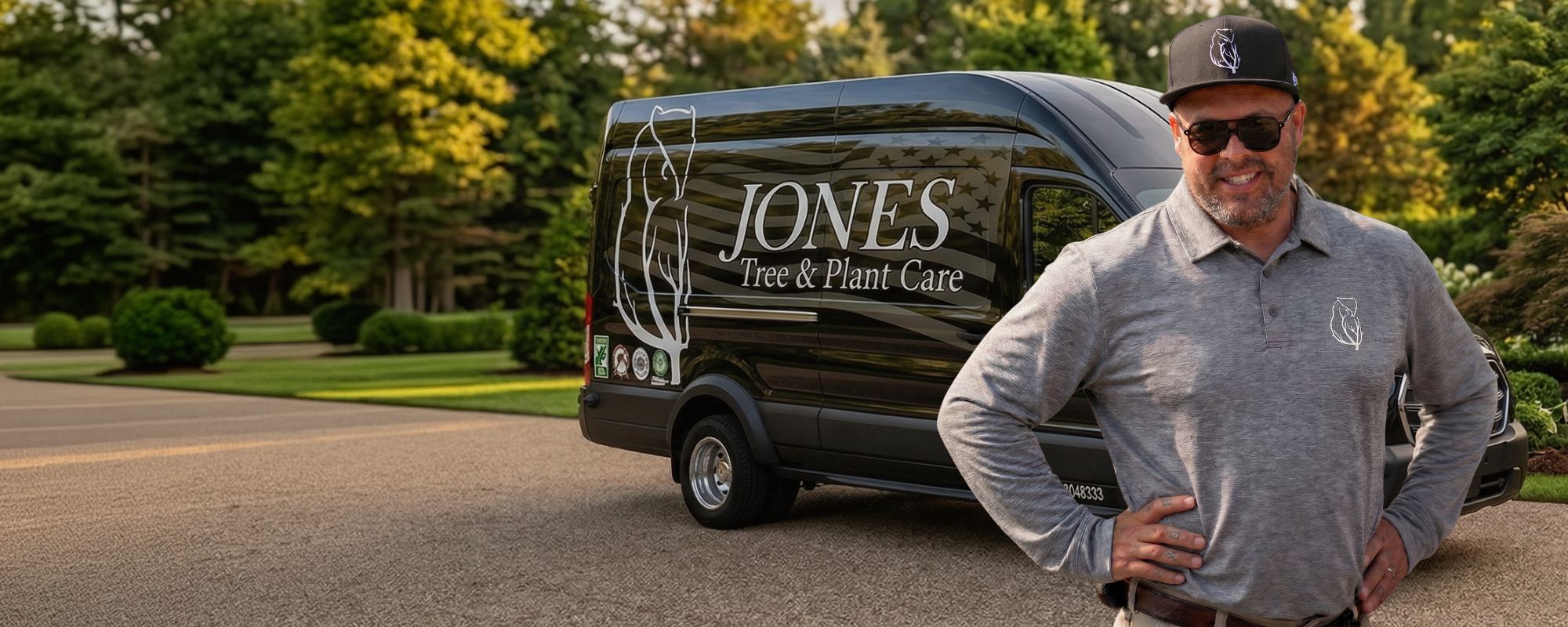
We offer free on-site consultations throughout Smithtown and all of Suffolk County. Thomas Jones — a NYS Board Certified Arborist and the owner of Jones Tree and Plant Care — personally attends every consultation and every job. He’s been doing this since 2014, and he’s been on every single job since day one. When you call or text us, you’re not getting a sales estimator. You’re getting the person who passed the state board exam.
What Happens During a Tree Removal Assessment in Smithtown?
Before any recommendation gets made, Thomas walks the property and looks at the full picture. That means checking the tree for structural issues, signs of disease, pest damage, and root zone health. It also means looking at what’s around the tree — structures, utility lines, neighboring properties, access points for equipment. All of that factors into both the removal approach and the final price.
If the tree shows signs of oak wilt, spotted lanternfly damage, or emerald ash borer activity, that gets flagged. Those aren’t just academic observations — they affect how the debris gets handled, whether treatment is a viable alternative, and whether nearby trees are at risk. Most crews aren’t trained to identify any of those three. It’s a gap that can cost Smithtown homeowners a lot more than they realize.
If a permit is required — and in Smithtown, Huntington, Brookhaven, and most other Suffolk County towns, it often is — we handle that paperwork for you. The standard permit process takes 10 to 20 days, so the earlier that gets started, the better. We’ve navigated the permit process across multiple municipalities and know what each town requires. You don’t have to figure that out on your own.
The consultation is also where the save-vs-remove conversation happens honestly. If there’s a realistic path to keeping the tree healthy, we’ll tell you. If removal is the right call, we’ll tell you that too — along with a clear, itemized quote that covers the full scope of the job, including stump grinding and debris removal if you want those included.
What Should You Ask Before Hiring a Tree Removal Company on Long Island?
This is a question worth taking seriously, because the range of operators in this market is wide. On one end, you have credentialed arborists with proper insurance and a decade of local experience. On the other, you have people with a truck and a chainsaw who will quote you a low number and leave you holding the liability if something goes wrong.
The first thing to ask is whether the company carries liability insurance and workers’ compensation. If a worker gets injured on your property and the company isn’t properly insured, you can be held responsible. Ask to see proof — not just a verbal confirmation, but an actual certificate. Any legitimate operation will have this ready without hesitation.
The second thing to ask is about credentials. “Certified arborist” gets thrown around loosely in this industry. A NYS Board Certified Arborist has passed a state board examination — that’s a specific, verifiable credential. It’s different from a business license or a manufacturer’s certification. If you’re dealing with a tree that’s showing signs of disease or pest damage, credentials matter in a very direct way.
Third, ask whether the quote covers everything — stump grinding, debris removal, and permit fees — or just the felling. Quotes that look competitive on the surface sometimes leave out significant line items. Getting that clarity upfront saves a lot of friction later.
And finally, if a company quotes you a price over the phone without ever seeing the tree, that’s a red flag. It might be a lowball number designed to get you to commit, or it might just be a guess that bears no resemblance to what the job actually involves. Either way, it’s not a quote you can rely on. A real assessment requires eyes on the tree.
Tree Removal in Smithtown: Get an Honest Answer Before You Decide
Tree removal cost in Smithtown, NY typically runs between $500 and $2,300, with an average around $1,400 for most Suffolk County jobs. But the price is only part of the decision. The more important question is whether removal is actually the right call — and that’s something only a qualified arborist can answer after seeing the tree in person.
Long Island’s active disease and pest environment, its mature hardwood stock, and its municipal permit requirements all make this a more complicated decision than it might look from the outside. Getting it right the first time protects your property, your liability, and in many cases, a significant amount of your home’s value.
If you’ve got a tree you’re concerned about anywhere in Smithtown or the broader Suffolk County area, we offer free on-site consultations with no pressure and no sales agenda. You can call or text us directly at (631) 334-2616 — texting is often the fastest way to get a response. We’ll come out, take a real look, and give you a straight answer.